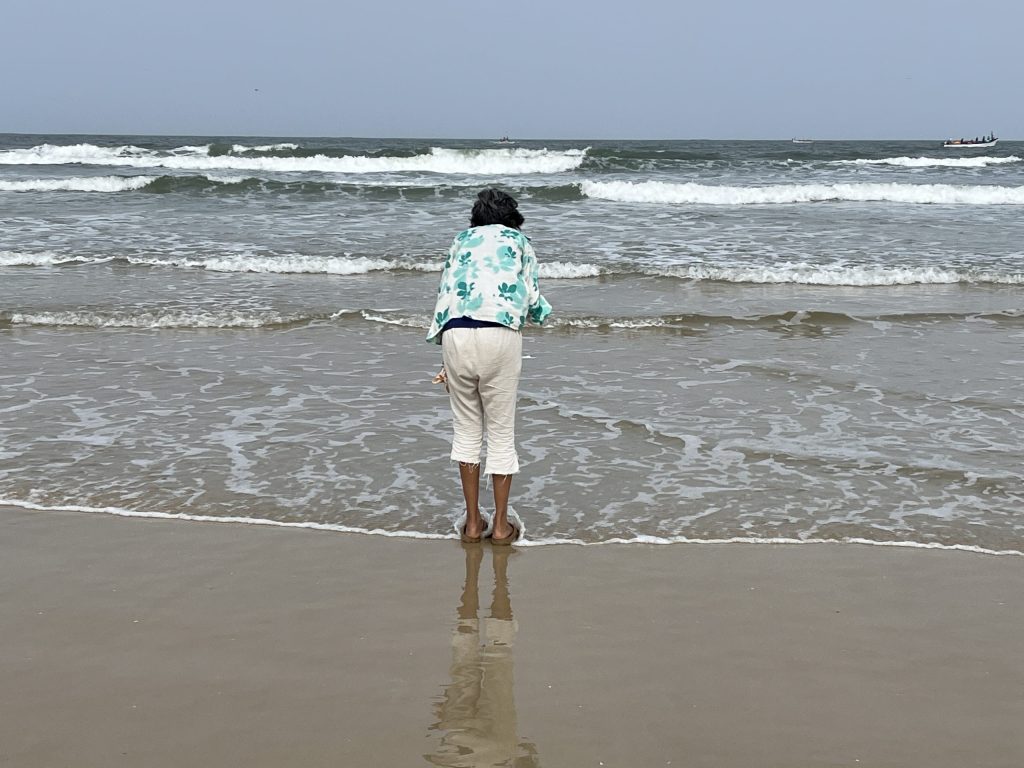
I saw this girl, standing barefoot at the ocean’s edge in Goa, watching waves that have been rolling for millennia. She’s doing something completely useless by modern standards. And it’s the most revolutionary thing either of us has done in years.
There’s a moment captured in this photograph that would make most productivity gurus cringe. A person standing still. Watching water. No fitness app counting steps, no camera documenting the “experience” for social media, no measurable outcome to justify the time spent.
Just… being.
And that, I’ve come to understand, is exactly what our overwhelmed minds are desperately craving.
When I Finally Chose Nothing Over Everything
The breaking point came in 2024. After years as a software engineer, climbing the productivity ladder, optimizing every moment of my life, my body finally sent me a message I couldn’t ignore: stop.
So I did something that terrified everyone around me. I took a six-month sabbatical. Not to learn new skills or start a side hustle or “find my passion.” Just to think. To breathe. To remember what it felt like to exist without an agenda.
October 2023: I went back to work, convinced I’d figured it out.
January 2025: I quit again.
This time, we made a bigger leap. We left Bangalore’s endless hustle and moved to the quiet beaches of Goa. Away from the metrics and meetings and the constant pressure to be more, do more, earn more.
Do I make money now? Not really. Am I figuring it out? Slowly. But here’s what I’ve gained: energy, clarity, and the radical realization that health is more important than money. In our culture of 23-year-olds celebrating hospital bills as “covering their expenses,” I’d forgotten this basic truth.
The Mental Health Crisis of Always Being “On”
We’re living through what psychologists are calling a mental health epidemic, and productivity culture is feeding it. In this hustle culture where everyone is in such a mad rush to earn money, gain influencers, build followers, young folks are burning out faster than ever before.
What’s truly scary is the twisted celebration of this burnout. I recently saw a tweet from a 23-year-old proudly announcing he’d just crossed $1,000 in monthly recurring revenue. The photo he posted? Lying in a hospital bed with a saline drip. His caption celebrated that this income would “cover his hospital bills easy.”
I stared at that image for a long time, wondering: is this what we call freedom? Yes, he’d escaped the 9-to-5. Yes, he’d built a successful business. But at what cost? When did we start measuring success by our ability to afford the medical bills our “success” creates?
Health is everything. And we’re trading it for metrics that mean nothing when we’re too sick to enjoy them.
The American Psychological Association reports that chronic stress—the kind that comes from never allowing ourselves to truly rest—leads to anxiety, depression, digestive problems, headaches, high blood pressure, sleep problems, and impaired concentration. When every moment must be justified, every activity must produce results, and every pause must be “mindful” in some measurable way, we lose something essential: the ability to simply exist without purpose.
According to the World Health Organization, more than one in eight people globally live with a mental disorder, with anxiety and depression being the most common. The irony is devastating. In our attempt to live fuller lives, we’ve forgotten how to live at all.
What I Mean by “Useless” Activities
Let me be clear about what I mean by useless. I’m not talking about mindfulness apps that gamify meditation or “self-care” that’s really just another form of self-improvement. I mean activities that serve absolutely no external purpose:
Watching waves without photographing them or timing how long you watch
Feeling soil between your fingers for no reason other than texture
Sitting with broken things before rushing to fix or discard them
Following a cat’s gaze to see what holds their attention
Breathing without counting breaths or tracking heart rate variability
Standing in doorways during transitions, not rushing from room to room
These moments offer no return on investment. They don’t make you a better person, boost your productivity, or advance your goals. They’re completely, utterly useless.
And that’s exactly why they’re healing.
The Science Behind Doing Nothing
Our nervous systems aren’t designed for constant stimulation and goal-directed activity. Research published in the Proceedings of the National Academy of Sciences shows that what neuroscientists call the “default mode network”—the brain’s resting state—is where integration, creativity, and emotional processing happen.
When we’re always “on,” always doing, always improving, we never access this restorative state. It’s like running a car engine at redline constantly and wondering why it breaks down.
Studies published in Nature have shown that spending time in nature—even just looking at natural scenes—reduces cortisol levels, blood pressure, and sympathetic nervous system activity while increasing parasympathetic activity (our rest-and-digest response).
The “useless” activities I’m describing aren’t meditation or mindfulness—they’re simpler than that. They’re moments when we give our minds permission to wander, to process, to just be without agenda.
Learning from Goa: Rest as Resistance
Moving from Bangalore’s relentless pace to Goa’s quiet beaches taught me that productivity culture isn’t just wrong—it’s completely divorced from how life actually works.
Here, watching my wife stand at the ocean’s edge, I see what I’d forgotten. The waves don’t rush. They follow their ancient rhythm—advancing and retreating, active and receptive, doing and being. The fishermen don’t optimize their morning routines. They go out when the sea calls, rest when it doesn’t.
Even the farm life we’ve embraced follows these cycles. Soil doesn’t improve itself constantly. It goes through periods of activity and rest, breakdown and buildup. The most productive gardens have fallow periods. Trees that fruit every year eventually exhaust themselves.
Yet somehow, we’d convinced ourselves that human beings were exempt from these natural cycles. That rest was laziness. That “useless” time was time wasted.
The Revolutionary Act of Stopping
Standing at the ocean’s edge like my wife in this photo, doing nothing productive, is actually a profound act of rebellion against a culture that commodifies every moment of our lives.
It’s saying: “My worth isn’t tied to my output.”
It’s declaring: “This moment has value even if it produces nothing.”
It’s asserting: “I exist beyond my usefulness.”
These aren’t small acts. In a world that profits from our constant motion, constant consumption, constant improvement, choosing to stop is revolutionary.
What I’ve Gained by Losing the Race
Six months into this slower life in Goa, something profound has shifted. The constant anxiety that had been my baseline has begun to quiet. Not because I’ve solved my problems or optimized my life, but because I’ve given my nervous system permission to rest.
Research from the Harvard T.H. Chan School of Public Health confirms what I’ve experienced: spending time in natural environments significantly improves mental health and cognitive function while reducing stress and anxiety.
I have more energy now than I did when I was “productive” all day. I see things more clearly. I’m figuring out a new reality where worth isn’t measured by income, where success looks like my wife standing peacefully at the water’s edge.
Do I worry about money? Sometimes. But I’ve learned the difference between having enough and having everything. Between being successful and being human.
Practical Ways to Practice Uselessness
You don’t need to quit your job or move to Goa to begin your own slow revolt. You can start with tiny acts of uselessness:
Morning doorway pausing: Before rushing into your day, stand in your doorway for thirty seconds. No agenda. Just notice.
Texture touching: Run your hands along surfaces—walls, fabric, bark—for no reason other than sensation.
Weather witnessing: Step outside not to exercise or get somewhere, but to feel air on your skin.
Transition breathing: Between activities, take three breaths without checking your phone or planning next steps.
Ocean watching: Find your version of my wife’s beach moment wherever you are.
The key is approaching these moments without trying to get something from them. The moment you start evaluating whether they’re “working,” you’ve missed the point.
Your Invitation to Revolt
I’m not asking you to abandon your career or move to a beach town. I’m inviting you to join a quiet revolution—one that happens in small moments when we choose presence over productivity, being over doing, useless over useful.
Find your version of standing at the ocean’s edge. Maybe it’s sitting with your morning coffee before checking your phone. Maybe it’s feeling the texture of your dog’s fur without simultaneously planning your day. Maybe it’s watching clouds without taking pictures.
Whatever it is, do it without agenda. Do it for no reason other than the radical act of existing without purpose.
In a world that profits from your constant motion, your stillness is rebellion.
In a culture that measures worth by output, your presence is revolutionary.
In a time of endless optimization, your uselessness is medicine.
The waves will keep rolling whether you’re productive or not. The question is: will you give yourself permission to stand still long enough to remember what it feels like to be human?
What “useless” moment will you claim today? Share in the comments below—not to be productive or helpful, but simply to honor the beautiful meaninglessness of being present.