
Slow Living Farm Lessons: The Tank That Taught Me to Think Again
A rusted industrial chimney section repurposed as a farm water tank — and the retired engineer who raised it with a car jack and patience — reminded me how to think for myself again.
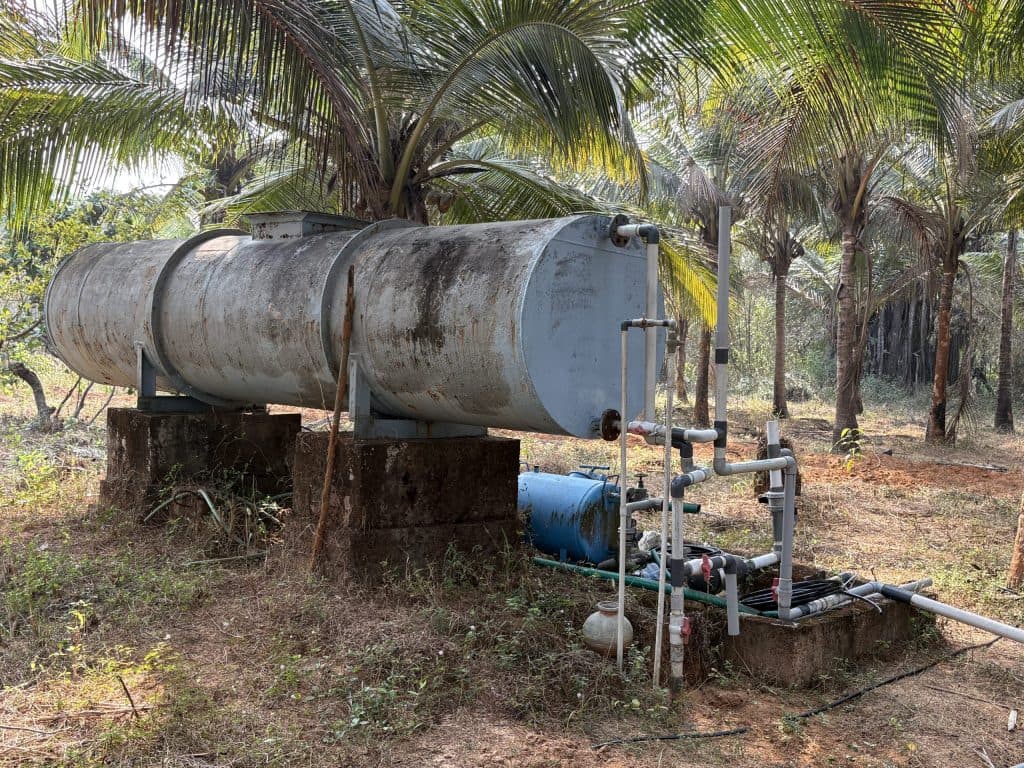
There is a rusted, weathered water tank sitting on my slow living farm. Two large cylindrical chambers welded together, raised about four feet off the ground on a concrete platform, flanked by coconut palms. Most visitors walk right past it. For the first few weeks after we moved in, so did I.
But something about farm life does something slow and quiet to you. The noise in your head starts to thin out. You stop scrolling, stop rushing, stop filling every silence with a podcast or a to-do list. And in that silence, you start to notice things again. The way light falls differently at 6am than at 8am. The sound the well makes when it is nearly dry. And one day, a tank.
I started looking at it differently. It was too large, too oddly shaped, too perfectly coated to be something you picked up at a hardware store. This was not an off-the-shelf water tank. Someone had made this. Someone had thought about this.
When my landlord visited next, I asked him about it. He is a man in his seventies, a retired engineer, and I will tell you this plainly: he has more energy and curiosity in a single morning than most people half his age carry through an entire week. I asked him where the tank came from.
"A factory scrapyard," he said. "It was part of a decommissioned industrial chimney."
I blinked.
He explained that the chimney section was already coated on the inside, which made it ideal for holding water. He had a welder cap the ends, and just like that, a piece of industrial waste became a farm water tank with a capacity most farmers can only dream of.
I stood there quietly for a moment, genuinely stunned. Not just at the cleverness of it, but at what it represented. Someone had walked into a scrapyard and seen not junk, but possibility. The object had not changed. Only the eyes looking at it had.
That should have been the whole story. But slow living has a way of revisiting you.
A few months later, I was sitting with a cup of herbal tea, not doing anything in particular, just looking out at the farm the way you do when your mind finally stops performing busyness. My gaze drifted to the tank again. And a new question surfaced.
How did he get it up there?
The tank sits elevated on a concrete platform, roughly four feet high. It is enormous and very heavy. Getting something like that raised would normally require a crane, a JCB, or at minimum, a large team of labourers. Farm labour is already hard to come by here. I started mentally calculating what a job like that would cost and how long it would take to coordinate.
As if on cue, my landlord walked in.
I asked him how he had raised the tank.
He smiled. "I did it myself. One labourer."
I laughed. I assumed he was joking.
He was not joking.
He broke it down. When the tank was transported from the scrapyard, he had it placed directly onto a rough stone platform that his labourer assembled on the ground. After the transport crew left, he got a car jack. He lifted one side of the tank slightly, his labourer slid more stones under it, and they poured a little concrete. Then they waited for it to set. A few days later, they lifted the other side. More stones. More concrete. More waiting.
Week by week, centimetre by centimetre, they raised that tank to its final height.
He did not hire a crane. He did not wait for a specialist. He looked at what he had, thought about the physics, and trusted the process.
"When I was managing a shop floor," he told me, "you almost never had the perfect resources. You had your team, you had the problem, and you had to figure it out. If you waited for professional help, the work would never get done."
I thought about that for a long time afterwards.
I spent years managing software teams. Good people, many of them. But there was a creeping culture I noticed towards the end, a reflexive reaching for reasons why something could not be done before anyone had seriously asked how it might be. Every blocker became a full stop. Every challenge became someone else's responsibility. And if I am honest with myself, I had started doing it too. I was so deep inside systems and processes and meetings that I had forgotten how to just think.
I think that erosion was part of why I left.
A few weeks ago, I went back to the city where I still have a home. One of the metal staircase railings had a corroded patch with a small hole, and water was seeping through. I called a welder who came, looked at it, and told me the structure was sound. He suggested filling it with cement and left.
A year ago, I would have stood there helplessly trying to find a contractor willing to take on a small job like that. I would have made calls, left messages, waited, followed up, and eventually done nothing.
This time, I stood there and just thought. What do I have? What does the problem actually need? I went to a hardware shop, bought a can of PVC foam spray, filled the gap, let it solidify, and sealed it with M-Seal. Done.
It was such a small thing. But I noticed it. I noticed the difference in how I approached it. Not "this is difficult, I need someone else." But "this needs fixing, let me see what I have."
That shift, that small interior shift, is what slow living gave me.
There is nothing magical about a farm. The coconut palms do not whisper ancient wisdom. The tank is just a tank. But when you slow down enough, when you stop filling every moment with motion and noise, you remember something you always knew: that most problems are solvable, and that the first tool you need is the willingness to think.
The engineer in his seventies did not have a crane. He had a car jack, a labourer, some stones, and patience. That was enough.
Slow living does not make you smarter. It just gives you back the time and quiet to use the intelligence you already had.
And sometimes, that is everything.
Written by Healing Soil