The Best Natural Soap for Eczema: What to Look For
Not all natural soaps are right for eczema. Here is what to actually look for: the ingredients that help, the ones that trigger flares, and what makes a bar genuinely safe for eczema-prone skin.
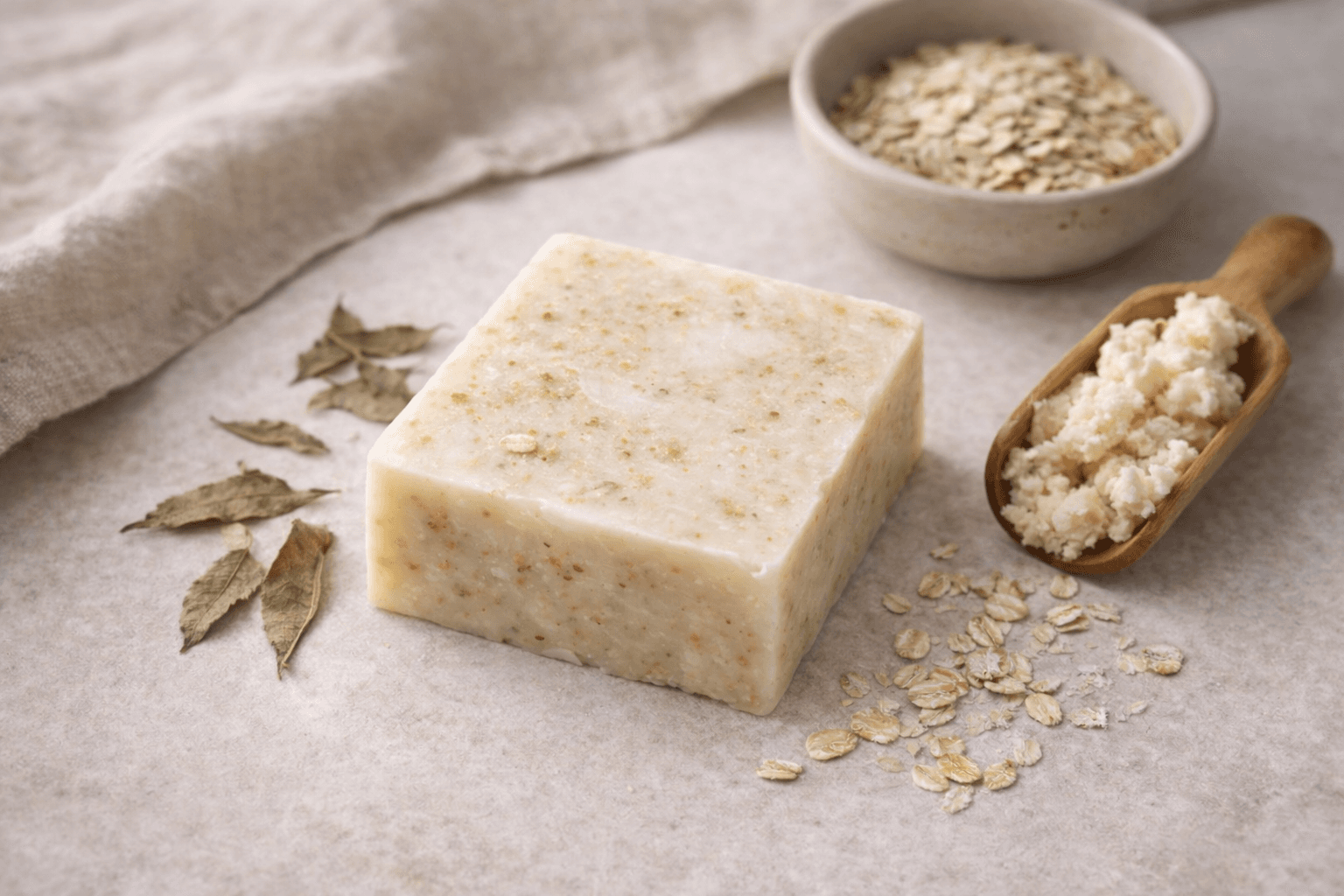
If you have eczema, you already know that soap is not a neutral product. The wrong bar can undo two weeks of careful management in a single shower. The right one can quietly reduce how often you flare.
The problem is that "natural" on a label does not mean eczema-safe. Essential oils are natural. Fragrances can be natural. Certain plant extracts are natural. Any of these can trigger a flare on sensitised skin. So the question is not just whether a soap is natural, but whether its specific ingredients support or disrupt a skin barrier that is already struggling.
This post works through exactly that question.
What eczema actually does to your skin
Eczema, more precisely called atopic dermatitis, is a chronic condition in which the skin's protective barrier does not function properly. Healthy skin holds moisture in and keeps irritants out through a tightly arranged outer layer (the stratum corneum) sealed with fats, proteins, and natural moisturising factors. In eczema skin, this layer has structural defects, often linked to mutations in the filaggrin gene, which disrupts the proteins that hold it together.
The result is skin that loses moisture faster than it should and lets irritants through more easily than it should. When something irritates that skin (a fragrance, a surfactant, a rough fabric), the immune system overreacts. The inflammatory response produces the redness, swelling, and intense itch that define an eczema flare.
This is why soap matters. You use it on your entire body, often daily. If it strips moisture or carries an irritant, it creates exactly the conditions that lead to a flare. Conversely, a soap that leaves the skin barrier intact, or actively supports it, removes one consistent daily trigger.
Why conventional soap makes eczema worse
Most soaps on the market, regardless of how they are marketed, contain ingredients that work against eczema-prone skin.
Sodium lauryl sulphate (SLS) and sodium laureth sulphate (SLES) are the foaming agents in most commercial body washes and liquid soaps. They clean by aggressively stripping oils from the skin surface. For healthy skin, this is inconvenient. For eczema skin, which is already failing to hold its barrier fats together, it is damaging. Studies have shown SLS directly disrupts the skin barrier and can trigger inflammation even in people without eczema.
Synthetic fragrance is listed on labels as "fragrance" or "parfum", a single word that can represent a blend of dozens or hundreds of individual compounds. The International Fragrance Research Association lists over 2,000 substances used in fragrance blends. Fragrance is the most common cause of allergic contact dermatitis and a consistent trigger for eczema flares. There is no safe minimum threshold for sensitised skin.
Parabens (methylparaben, ethylparaben, propylparaben) are preservatives found in liquid soaps and some bar soaps. They have been shown to increase skin sensitivity and are worth avoiding as a precaution.
Alcohol (ethanol or denatured alcohol) is sometimes added to soaps and washes as an antibacterial agent. It is also a drying agent that directly impairs skin barrier function.
Artificial colourants serve no skin benefit. Several common dyes have been associated with skin reactions, and they add unnecessary chemical load for skin that is already reactive.
Formaldehyde-releasing preservatives (such as DMDM hydantoin, diazolidinyl urea, imidazolidinyl urea) are used in many liquid body washes. Formaldehyde is a known sensitiser. Even at low concentrations in a rinse-off product, it is worth avoiding on eczema-prone skin.
What to look for in a soap for eczema
The short version: you want a soap that cleans without stripping, adds moisture back during washing, and contains no known irritants.
Here is what that means ingredient by ingredient.
Retained glycerin
Glycerin is a byproduct of the soap-making process. Commercial soap manufacturers extract it because it is more profitable to sell separately. A quality handmade soap uses a base that retains it. It is a humectant: it draws moisture from the air and from deeper layers of the skin toward the surface. Washing with a glycerin-rich soap means your skin is being actively moisturised during the wash, not just cleaned. A short, readable ingredient list and a transparent maker are the best indicators that the glycerin is still there.
Shea butter
Shea butter contains fatty acids that are structurally close to the lipids in human skin. When included in soap at a superfat level, these fatty acids deposit on the skin during washing and are left behind after rinsing. They reinforce the skin barrier rather than stripping it. Shea butter also contains non-saponifiable compounds, specifically cinnamic acid esters and lupeol, that have documented anti-inflammatory properties. This is particularly relevant for eczema skin, where inflammation is the underlying mechanism of every flare. Raw shea butter retains these properties; highly refined versions do not.
Goat milk
Goat milk contains lactic acid, an alpha hydroxy acid that gently exfoliates the outer layer of dead skin cells without mechanical friction. It also contains vitamins A, B2, B3, and B12, along with proteins and natural fats. The fat content makes a goat milk soap feel particularly creamy and non-stripping. Lactic acid specifically can help normalise the slightly disrupted pH of eczema skin. The result is a soap that gently resurfaces without triggering the friction-related irritation that eczema skin is prone to.
Neem
Neem oil comes from the seeds of the Azadirachta indica tree and has been used in Ayurvedic medicine for skin conditions for thousands of years. It contains nimbidin and nimbin, which have clinically studied anti-inflammatory properties, and has demonstrated antibacterial activity against Staphylococcus aureus, the bacteria that colonises eczema skin and worsens flares. If your eczema is accompanied by frequent bacterial infections at scratch sites (as it often is), neem in a soap is a genuinely useful ingredient, not just a marketing claim.
Oatmeal
Colloidal oatmeal (oats ground fine enough to stay suspended in water) is one of the few ingredients the FDA has approved as a skin protectant for eczema. It contains avenanthramides, compounds with measurable anti-itch and anti-inflammatory effects. It also forms a physical film on the skin surface that reduces transepidermal water loss. A soap containing finely ground oatmeal delivers these benefits during the wash. The mechanism is well understood and the evidence is solid.
Short ingredient lists
The fewer ingredients, the fewer potential triggers. If you cannot identify every ingredient in a soap, that is itself a risk factor for eczema-prone skin. The ideal eczema soap has an ingredient list you can read in ten seconds.
What to avoid: the full list
For easy reference:
- Sodium lauryl sulphate (SLS)
- Sodium laureth sulphate (SLES)
- Fragrance / parfum (including "natural fragrance")
- Essential oils on sensitised skin (lavender, citrus, and mint are common triggers)
- Parabens (methylparaben, propylparaben, butylparaben)
- Alcohol / ethanol / denatured alcohol
- Artificial colourants (FD&C dyes, D&C dyes)
- Formaldehyde-releasing preservatives (DMDM hydantoin, quaternium-15)
- Cocamidopropyl betaine (a common sensitiser in "gentle" washes)
- Triclosan and other synthetic antibacterials
A note on essential oils: they are natural, they smell good, and they are one of the more common triggers on eczema skin. Sensitised skin does not distinguish between natural and synthetic fragrance molecules. If your eczema is well-managed and you have no history of reactions to a specific oil, a low concentration may be fine. If you are in a flare or are newly switching to natural soap, unscented is the safer starting point.
Practical things that matter beyond ingredients
Water temperature. Hot water opens the skin and strips barrier fats faster than warm water does. Warm, not hot, is better for eczema skin regardless of what soap you use.
How long you wash. Brief contact time means less exposure to even the gentlest surfactants. Soap the skin, rinse, finish. You are not trying to sterilise.
How you dry. Pat, do not rub. Friction on inflamed or post-wash skin is a direct irritant. Pat dry and apply any leave-on treatment within a few minutes while the skin is still slightly damp.
Bar soap vs. liquid soap. Bar soaps generally have simpler ingredient lists and do not require the preservative systems that liquid soaps do. For eczema-prone skin, a well-made bar soap is often the safer format.
Consistency. Skin barrier function improves gradually with sustained reduction in irritant exposure. A single wash with an eczema-safe soap will not transform your skin. Three weeks of using it daily usually will. Give a new soap time before judging it.
What to actually buy
If you are looking for a place to start:
A shea butter and goat milk soap covers the most ground for eczema. Shea butter addresses the barrier and inflammation. Goat milk addresses pH and gentle exfoliation. Together they produce a soap that cleans, conditions, and does not trigger. Our shea butter and goat milk soap is made with raw shea butter, whole goat milk, and no synthetic fragrance or colourants.
A neem soap is worth adding if bacterial colonisation is a problem: if you notice eczema patches getting infected after scratching, or if your eczema tends to be weepy. The antibacterial properties of neem work without the skin-stripping effect of synthetic antibacterials.
If you want to keep things simple: start unscented, start with a short ingredient list, and start with one bar. Your skin will tell you whether it is working.
Frequently asked questions
Can natural soap cure eczema? No. Eczema is a chronic condition driven by genetics and immune system response. No topical product cures it. What the right soap can do is remove a daily irritant and reduce the frequency and severity of flares.
Is handmade soap better for eczema than commercial soap? Generally yes, for two reasons: a quality handmade soap retains its glycerin, which commercial soap does not, and handmade soap typically uses simpler, more transparent ingredient lists with fewer synthetic additives.
What if I react to a natural soap? Stop using it and let the skin recover. Identify which ingredient might be responsible. Essential oils and certain plant extracts are the most common culprits in natural soap reactions. Switch to a simpler, unscented bar and reintroduce complexity slowly.
How long before I see improvement? Most people notice a difference in skin texture and moisture within one to three weeks of consistent use. Reduction in flare frequency takes longer: it reflects cumulative improvement in skin barrier function, which does not happen overnight.
Can I use natural soap on a child with eczema? Yes. A well-made, unscented natural soap with a short ingredient list is appropriate for children with eczema. Avoid any soap with essential oils, fragrance, or coloured bars, which are often marketed at children but are not appropriate for sensitive skin.
Eczema is not something you solve once. It is something you manage, and the products you use daily are part of that management. Soap is not a minor detail. It touches every part of your skin, every day. Using one that supports rather than disrupts your skin barrier is one of the simplest and most consistent changes you can make.
You can explore our soaps in the shop. If you are unsure where to start, the shea butter and goat milk bar is usually the right one for eczema-prone skin.
Written by Healing Soil
Try our handmade soaps
Made to order from our farm in Goa. No chemicals. No shortcuts.
Shop the collection