The Peel That Skin Remembers: A Pomegranate Story

Try the starter bundle
Four soaps, ₹1,000. SLS-free, made to order from Goa. Free shipping.
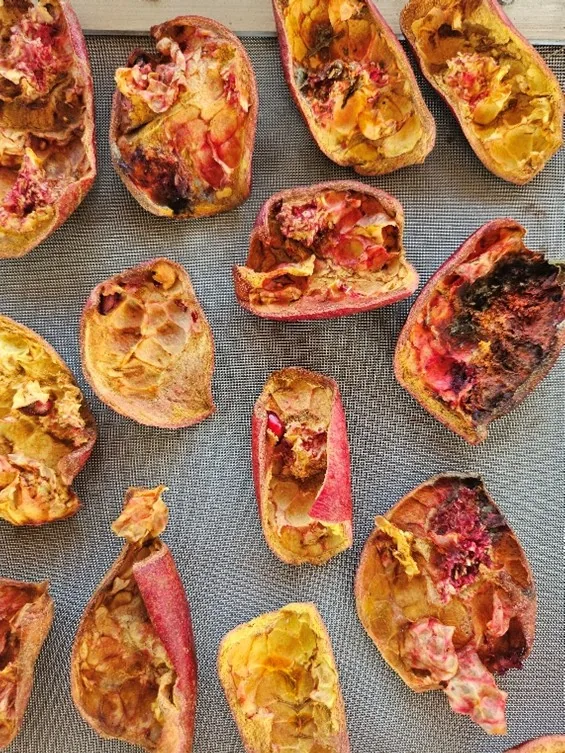
Close your eyes for a moment. Imagine a hot summer afternoon, the kind where the air is thick and still, and the sun sits overhead like a relentless lantern. On a tray laid out in your courtyard, a bed of deep crimson pomegranate peels slowly surrenders its moisture to the heat. They are not discarded scraps. They are something more. Almost alchemical. Absorbing the very energy of the sun as if following an instruction older than memory.
The pomegranate has always been a fruit of consequence. Revered in the Bible as one of the seven blessed fruits of the promised land, it has adorned ancient temples, graced royal tables, and appeared in sacred texts across cultures as a symbol of life, fertility, and renewal. Perhaps it is no coincidence then, that the very part we tend to discard. Its thick, jewel-toned peel holds some of the most potent gifts for our skin.
"In ancient texts, the pomegranate was not just food. It was medicine, symbol, and sacrament. Its peel, turns out, may be its most powerful offering of all."

Why the peel? The science behind the ancient wisdom
While the arils get all the glory, pomegranate peel contains an even higher concentration of bioactive compounds than the fruit itself. Rich in tannins, ellagic acid, punicalagins, and a suite of antioxidants, the peel is, quite literally, the fruit's armour, designed by nature to protect against the elements. When applied to skin, it performs a similar function.
✦ Powerful antioxidant
Ellagic acid and punicalagins fight free radicals, keeping skin looking fresh and luminous.
✦ Environmental resilience
The peel's compounds help skin cope with daily environmental exposure, supporting its natural resilience.
✦ Traditional cleansing
Tannins and polyphenols have been part of traditional skin care for generations, valued for their role in keeping skin feeling clean and clear.
✦ Brightening and even tone
Regular use leaves skin looking more even and radiant over time.
✦ Skin nourishment
Pomegranate peel is rich in compounds associated with skin enzyme activity, leaving skin feeling supple.
✦ Gentle texture
The fine powder adds a gentle texture that leaves skin feeling smoother and more refreshed after each wash.
Try it at home: three simple ways
Before it ever makes its way into a soap bar, pomegranate peel powder is something you can begin using right now, with nothing more than a teaspoon and a few pantry staples. Here are three ways to let the peel do its work.
Simple home uses for pomegranate peel powder
Brightening face mask
Mix 1 tsp fine powder with raw honey and a few drops of rose water into a smooth paste. Apply to clean skin, leave for 15-20 minutes, then rinse gently. Use 2-3 times a week for a visibly more even tone.
Gentle face scrub
Combine 1 tsp powder with yoghurt or coconut oil to form a thick paste. Massage in gentle circles onto damp skin for a minute, then rinse. The mild grit buffs away dullness without irritating the skin.
Clarifying toner boost
Stir half a teaspoon into warm water, let it steep for a few minutes, then strain and use as a rinse after cleansing. The tannins help calm any redness, leaving skin feeling refreshed and balanced.
A patch test is always a good idea before first use, especially for sensitive skin. The powder's natural astringency is potent. A little goes a long way.
Healing Soil
At Healing Soil, we take this powder one step further, locking its benefits into a bar you can use every single day.
The Healing Soil Way: a story in four acts
There is something deeply satisfying about making something from something that was almost nothing. Our soap begins not in a laboratory, but with the quiet ritual of peeling a pomegranate and choosing not to throw the skin away.
1. The harvest
After the fruit is enjoyed, the thick, leathery peels are collected, each one a deep garnet red, still fragrant and alive. This is where most people would reach for the bin. At Healing Soil, we reach for a tray instead, because the best ingredients are often the ones we overlook.
2. The drying: sun as collaborator
The peels are first laid out in the shade for a couple of days, allowing the internal moisture to slowly release without cooking away the delicate compounds. Once the juices have dried and the peels have stiffened, they are moved into direct sunlight, or placed in a solar dryer, for a final, thorough drying.
This is perhaps the most poetic step: the same sun that the pomegranate soaked up as it ripened on the vine is invited once more, this time to concentrate the peel's power, binding its goodness into a form that will last. The colour deepens. The texture becomes dry and crisp. The peel is ready.
3. The grinding: one peel, two powders
This is where the process reveals a small, quiet brilliance. The dried peels are ground, and as they break down, they yield not one but two distinct powders, each with its own destiny.
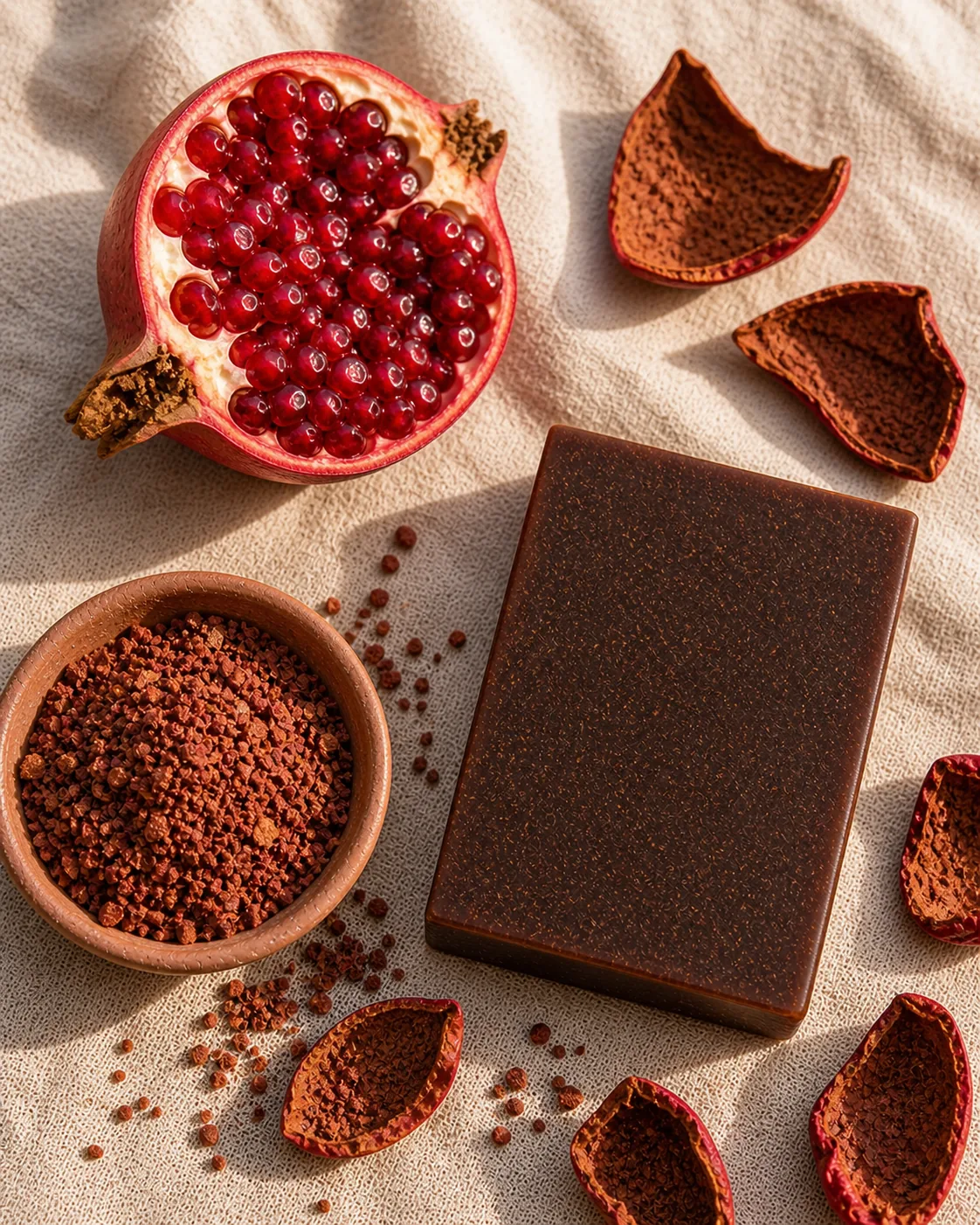
The first pass produces a silky, fine dust: the colour of dried roses, smooth enough to dissolve invisibly into any base. The second yields something grainier and more textured, coarser granules with a gentle roughness that catches between the fingers. Rather than grinding everything to the same consistency, the two are separated and set aside for different roles. Nothing is wasted. Everything has a purpose.
Fine powder. Silky, smooth, rose-toned dust that blends seamlessly into melted soap base, infusing every lather with antioxidants and brightening compounds.
→ Stirred into the melted soap base
Coarse powder. Grainy, textured granules with a gentle roughness, held back from the main blend, waiting for the moment of casting to do their work.
→ Pressed into the top layer at casting
4. The making of a bar of two faces
The soap base is gently melted until silky and clear. A tablespoon of the fine powder is stirred in slowly, turning it a soft, blushing rose, an even suspension of pomegranate goodness throughout every molecule of lather.
But just before the soap is left to fully set, the coarser granules are scattered across the top of the mould and gently pressed in. As the soap solidifies, it captures them in its surface, locked into place, forming a layer that is visibly and texturally different from the smooth underside.
The result is a bar with a dual personality: one side glassy and gentle, perfect for the face and sensitive skin; the other, scrubby and purposeful, ready to wake up tired legs or rough elbows. One bar. Two experiences. Designed entirely by the peel itself.
Coarse peel granules, textured scrub surface
Melted soap base infused with fine pomegranate powder antioxidants · brightening compounds distributed evenly throughout
Smooth, glossy underside, gentle on face and sensitive skin
"One peel. Two powders. Two textures. A single bar that knows exactly what your skin needs and when."
So the next time you eat a pomegranate and find yourself holding the spent peel, pause. Set it in the sun. Let it dry. Grind it. And make something beautiful from what was almost lost. The ancient world knew the value of this fruit in full. At Healing Soil, we are simply trying to remember.
Ready to make the switch?
Bring pomegranate into your daily routine, without the prep work.
The masks, the scrubs, the steep times, they're wonderful. But some mornings, you just need a bar of soap that does the work for you. Our Healing Soil Pomegranate Soap is handcrafted with the same sun-dried peel powder, built into every lather and pressed into every scrub side, ready whenever you are.

Pomegranate Glycerin Soap (₹250) · Pomegranate Goat Milk Soap (₹350)
Handmade in small batches · No synthetic additives · Zero waste process
Written by Healing Soil
Try the starter bundle
Four soaps to find the one your skin agrees with. ₹1,000. SLS-free, made to order from Goa.
Shipped in 4 days. Free shipping included.
See the starter bundleWant the full picture? Read our complete guide to handmade soap in India.