The complete guide to handmade soap in India
What commercial soap does to your skin, how to read a label, which base suits your skin type, and why the soap you use every day matters more than most skincare products combined.
What commercial soap actually does
Most commercial soap bars in India are not really soap. They are detergent bars — synthetic foaming agents compressed into bar form and sold in packaging that says things like “moisturising” and “gentle.”
Soap formulas vary widely. Glycerin bases generally create a light, smooth lather; goat milk bases feel creamier; and shea butter bases provide the richest, most conditioning texture.
SLS is one ingredient used in some cleansing products to create fast foam. Healing Soil bars do not contain it, but a useful comparison should still look at the entire formula rather than a single ingredient.
Handmade soap keeps the glycerin in. It skips the SLS. The lather is lighter, the feeling after washing is different, and for people who have been reacting to commercial soap for years, the change is often noticeable within a week.
How to read a soap label
Indian soap labels follow INCI (International Nomenclature of Cosmetic Ingredients) naming, so the same ingredient appears the same way on every pack. Ingredients are listed from highest to lowest concentration. Here is what to look for:
Avoid
- Sodium Lauryl Sulfate (SLS) and Sodium Laureth Sulfate (SLES) — different surfactants that should be checked separately.
- Fragrance or Parfum — label terms that describe added scent without always naming each scent material.
- Parabens — methylparaben, propylparaben, butylparaben. Synthetic preservatives. Lower priority than SLS and fragrance, but a clean label leaves them out.
- Triclosan — a synthetic additive found in some bars. Worth avoiding where the bar lists it.
Good signs
- A short list you can read aloud without stumbling.
- Saponified oils listed by name — saponified coconut oil, saponified olive oil, saponified castor oil.
- Glycerin listed as an ingredient (means it was kept in rather than extracted).
- Named plant extracts — neem leaf extract, tulsi extract — rather than “herbal blend” or “botanical complex.”
Read more: What does “chemical-free soap” actually mean? and, if your skin prefers mild products, natural soap for sensitive skin in India.
The three soap bases and which skin type each suits
Most handmade soap in India is built on one of three bases: glycerin, goat milk, or shea butter. Each behaves differently on skin and suits different needs.
Glycerin — for oily, combination, or normal skin
Glycerin soap has a light lather and an easy-rinsing feel. Choose it when you want a smooth daily bar without the richness of goat milk or shea butter.
Read more: Glycerin vs goat milk soap: which suits Indian skin?
Goat milk — for sensitive or dry skin
Goat milk gives the soap base a creamy texture and a richer lather than glycerin. It is a versatile option suitable for sensitive and dry skin types, as well as anyone who simply prefers a creamier wash.
Read more: Goat milk soap: ingredients, lather, and feel and Shea butter + goat milk for dry, sensitive skin.
Shea butter — for very dry, mature, or tight-feeling skin
Shea butter is the richest of the three bases. The lather is thick and creamy, and the after-wash feel is conditioning. Choose it when you enjoy a fuller texture.
Read more: Shea butter in soap: what it does and what it cannot
Indian skin, Indian climate, and why both matter
Indian skin varies significantly across the population — from oily combination skin common in humid coastal regions to dry, reactive skin in drier inland areas. The climate adds its own variables: high humidity in cities like Mumbai, Bangalore, and Goa means skin already manages sweat and heat all day; drier conditions in Delhi or Pune in winter mean the same skin can become tight and reactive by December.
The practical rule: in summer and monsoon, lean toward glycerin or goat milk (lighter bases). In winter or dry months, lean toward goat milk or shea butter (more nourishing). If you are sensitive year-round, goat milk handles the full range better than any other base.
Soap storage matters in Indian humidity. Keep the bar dry between washes — a perforated soap dish or a hanging pouch lets water drain away. A bar that sits in a wet dish dissolves faster and grows mushy. Rotate between two bars if possible, letting each one dry completely.
Ingredients that come from somewhere
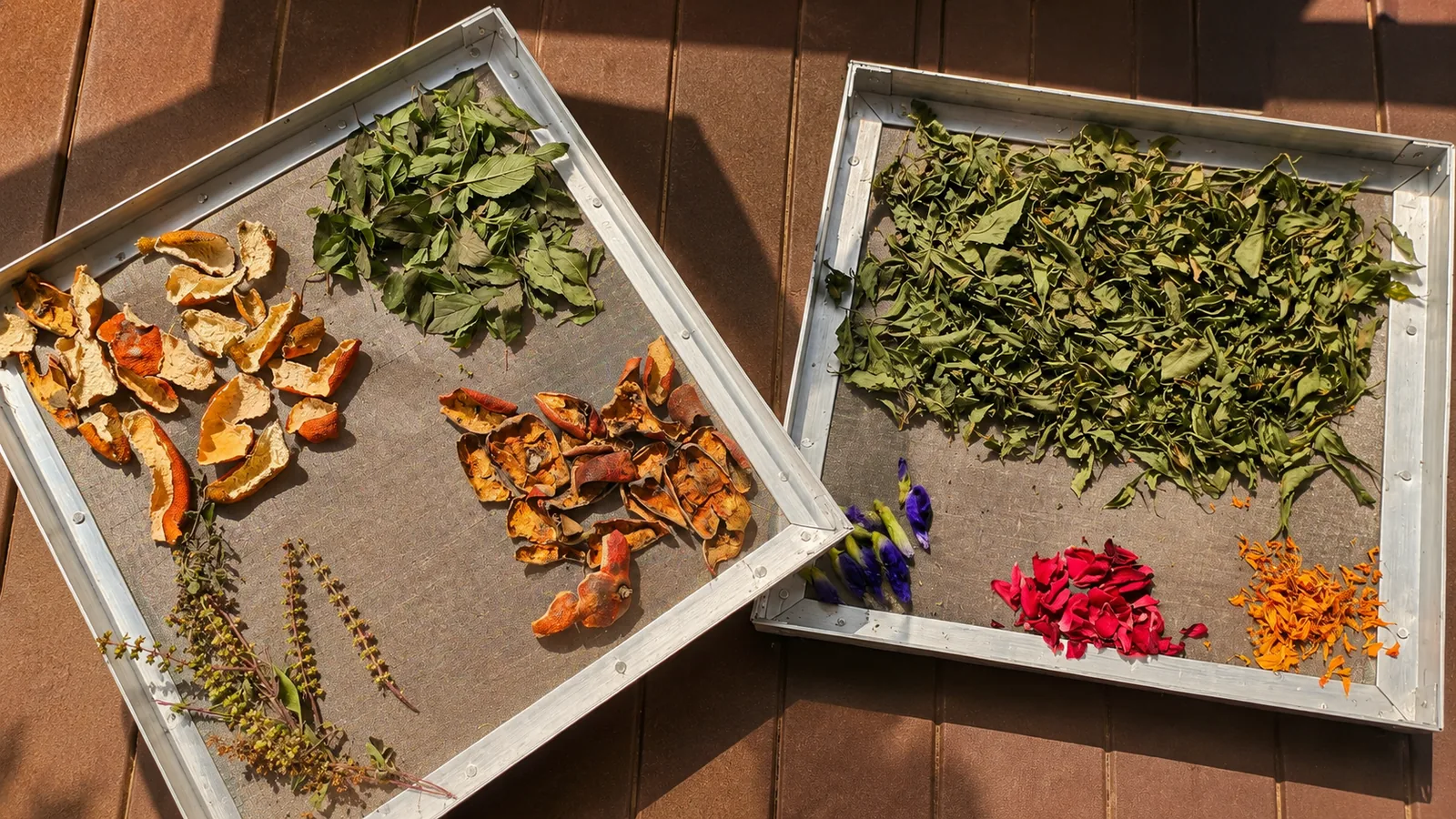
Neem and tulsi have been used in personal care and home routines across India for generations. Both are central to Ayurvedic practice and are grown on our farm in South Goa. In a soap, they contribute a distinctive earthy, herbal scent and a feel that is recognisably traditional. When these ingredients are grown on the farm rather than bought as synthetic extracts, the provenance is traceable.
Read more: Neem and tulsi soap: what these two ingredients actually do
Why handmade soap behaves differently
Handmade soap is made in small batches and sold without the shelf-life pressure of mass production. Healing Soil bars are melt-and-pour: pre-made bases are melted and hand-poured with botanicals to order, then shipped within days, not held in stock. Each batch is slightly different because natural ingredients are not uniform.
The result is a bar that lasts longer than most people expect — because glycerin-rich, SLS-free bars dissolve more slowly than commercial detergent bars. A single bar used correctly can last four to six weeks. Read more: Why our handmade soap lasts longer than you expect
Small-batch production also means what you receive was made for your order, not sitting in a warehouse for months. Read more: Why we make soap in small batches
From the farm
The soap Healing Soil makes starts on a farm in South Goa. The neem and tulsi are grown there. The glycerin and goat milk bases come from a manufacturer used since the start. Everything is melted, hand-poured, and shipped to order. If you want to understand what that looks like in practice, two stories give the full picture:
- Handmade soap for sensitive skin: a gentle label guide — how to compare SLS, parabens, fragrance, soap bases, and after-wash feel.
- From a sagging neem branch to DIY soap — how a monsoon-bent neem branch turned into a DIY session that stocked the bathroom for three months.
Go deeper
Every section of this guide has a detailed companion article.
- Natural soap for sensitive skin in India: what works and what to avoid
- Glycerin vs goat milk soap: which suits Indian skin?
- Shea butter + goat milk soap for dry, sensitive skin
- Shea butter in soap: what it does and what it cannot
- Goat milk soap: ingredients, lather, and feel
- Neem and tulsi soap: what these two ingredients actually do
- What does "chemical-free soap" actually mean?
- Why our handmade soap lasts longer than you expect
- Why we make soap in small batches
Made by hand in South Goa
Handmade soap with no SLS, parabens, or synthetic fragrance. Send us a message on WhatsApp and we will help you find one that suits you.