Healing Soil
HandmadeNo chemicalsSmall batchMade to orderGoa
skincare

SLS-free soap in India: what it means and why it matters for your skin

Most commercial soaps sold in India contain SLS, a detergent that strips your skin every time you wash. Here is what SLS is, why it causes problems for Indian skin specifically, and how to find soap without it.

SLS-free soap in India: what it means and why it matters for your skin

Try the starter bundle

Four soaps, ₹1,000. SLS-free, made to order from Goa. Free shipping.

See the bundle

If your skin feels dry or tight after a shower, the soap is usually the reason.

Not the water. Not the weather. The soap.

Most commercial soap bars sold in India, including the ones positioned as gentle or moisturising, contain sodium lauryl sulfate. SLS, as it is commonly written on labels. It is a detergent. It creates lather fast, cleans effectively, and is cheap to manufacture with. This is why it is in almost everything.

The problem is that SLS does not just remove dirt. It removes the oils your skin produces to protect itself. Every time you wash, you strip that layer. Your skin then works to rebuild it. If you are washing once or twice a day with an SLS-based soap, your skin is in a constant cycle of being stripped and trying to recover.

For a lot of people, that cycle is what causes the dryness, the tightness after washing, the flakiness, and the irritation that comes and goes without an obvious cause.

Why this hits harder in India

Indian skin is not a monolith, but there are some common patterns.

Most people in India wash more frequently than people in cooler climates. Once in the morning and once in the evening is normal in Bangalore or Goa in summer. That means two rounds of SLS contact daily. The cumulative stripping adds up.

Indian tap water is also often harder than average, with higher mineral content. Hard water makes it harder for skin to retain moisture after washing. Combined with an SLS-based soap, the dryness compounds.

And then there is the climate itself. High humidity can make skin feel oily, which leads people to use more soap, or use stronger soap, to feel clean. SLS-heavy formulations are positioned as "deep cleansing" but deep cleansing is often just excessive stripping.

None of this is catastrophic. But it does explain why so many people in India with no diagnosed skin condition still deal with persistent dryness, sensitivity, or irritation that does not fully resolve.

What SLS-free actually means

SLS-free means the soap does not contain sodium lauryl sulfate or its close relative, sodium laureth sulfate (SLES). SLES is a slightly milder version of the same detergent. Some brands use it as a swap and still market the product as gentler. It is somewhat gentler, but not fundamentally different in how it acts on skin.

A genuinely SLS-free soap gets its lather from the soap-making process itself, not from added detergents. The saponification of natural oils and fats produces a mild lather naturally. It is not the aggressive foam of a commercial bar, but it cleans well.

The feeling after washing is different. Skin feels clean but not stripped. Not tight. Not waiting for the moisturiser.

How to read a soap label

The ingredient list on a soap bar follows the same pattern as food labels: highest quantity first. SLS and SLES, if present, will usually appear in the top five ingredients. Look for:

  • Sodium lauryl sulfate
  • Sodium laureth sulfate
  • Sodium coco sulfate (a slightly different compound but behaves similarly)
  • Ammonium lauryl sulfate

If none of those appear, the soap is at least SLS-free. That does not automatically make it good. There are other synthetics to watch for, including parabens (preservatives), synthetic fragrance listed simply as "fragrance" or "parfum", and PEG compounds. But the SLS check is the first and most useful one.

Handmade soaps in India will often list their ingredients using the INCI (International Nomenclature of Cosmetic Ingredients) format, which uses the Latin names of base oils. So the glycerin base in a handmade bar might appear as "glycerin" and the carrier oils as "cocos nucifera oil" (coconut) or "butyrospermum parkii butter" (shea butter). These are fine. You are looking for the sulfate compounds specifically.

What to look for instead

SLS-free soap works through the natural properties of its base and added ingredients. The base carries most of the cleansing function. The added ingredients support the skin.

A few bases that work without SLS:

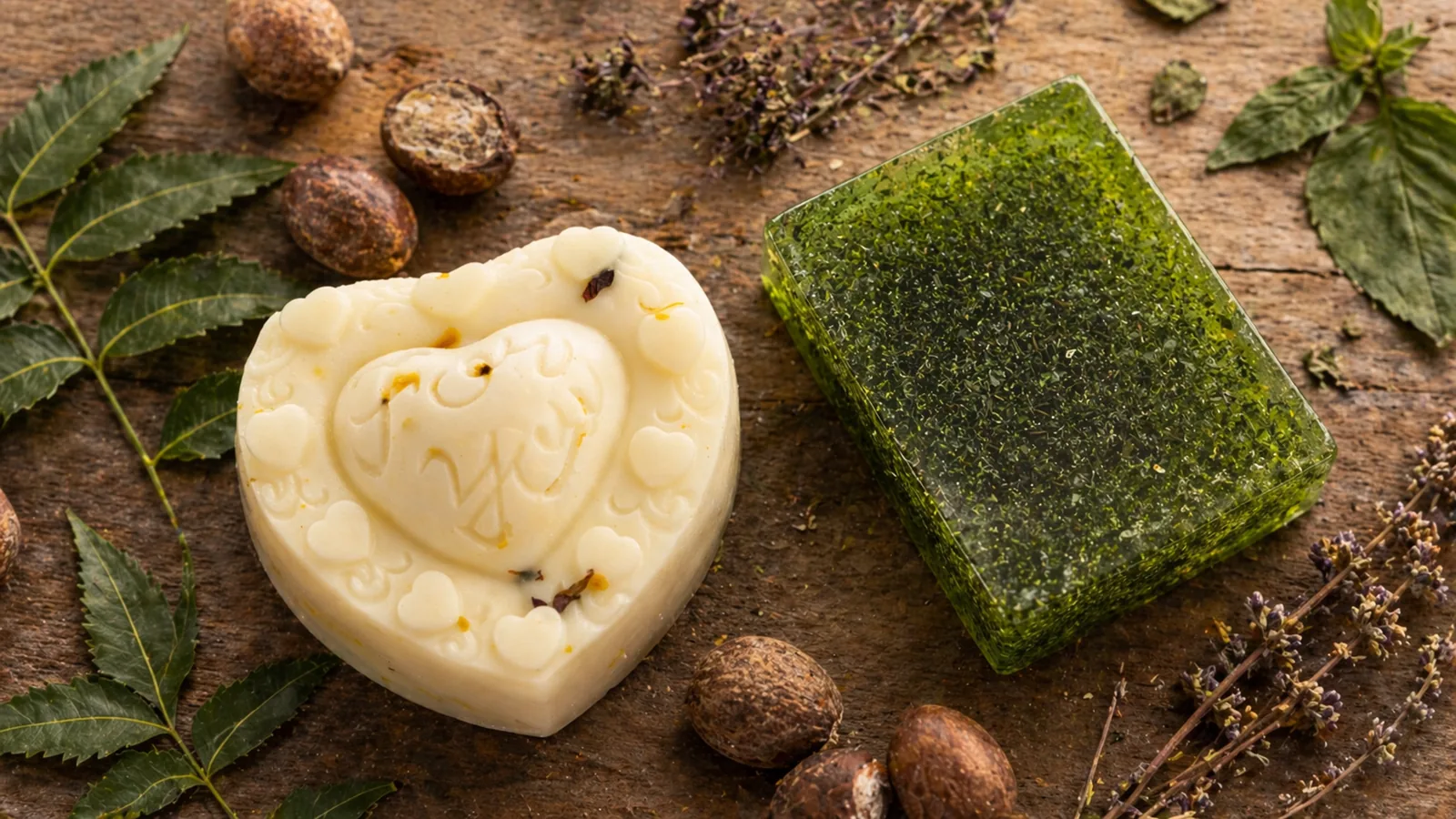
Glycerin base: Glycerin is a by-product of the soap-making process. Commercial soap manufacturers extract it because it is valuable on its own. In a handmade glycerin bar, it stays in. Glycerin draws moisture into the skin as you wash, so the act of cleaning is also gently hydrating. Good for oily or combination skin.

Goat milk base: Goat milk replaces water in the base. It contains lactic acid, which gently loosens dead skin, and natural fats that absorb easily. The result is a bar that cleans, smooths, and nourishes in one step. Good for sensitive, dry, or reactive skin.

Shea butter base: Shea butter is high in fatty acids that do not fully break down during saponification. Some of it remains in the bar and deposits on your skin when you wash. After rinsing, a thin layer stays and keeps skin soft. Good for very dry skin and for skin that feels tight in winter or after washing.

None of these bases need SLS to clean. The lather is gentler than what you are used to from commercial soap, but the cleansing is real.

One thing worth knowing about switching

If you switch from commercial soap to an SLS-free handmade bar, the first week can feel strange.

Your skin has been producing excess oil to compensate for the constant stripping. When the stripping stops, it takes a few days for oil production to normalise. You might feel slightly oilier than usual at first. That settles.

The tight feeling after washing should reduce immediately. The dryness usually improves within two to three weeks. For people with eczema or persistent irritation, the improvement is often more noticeable, though not guaranteed.

Skin is specific. What works for one person may not work for another. But switching to an SLS-free bar is one of the lowest-risk things you can do if your skin is reacting to something and you have not been able to identify the cause.

Where to start

If you want to try an SLS-free soap, the starter bundle at Healing Soil covers all three bases, glycerin, goat milk, and shea butter. It is made to order in small batches in Goa. No SLS, no parabens, no synthetic fragrance.

The bundle is a practical way to find out which base works for your skin before committing to a full bar of each.

Written by Healing Soil

Try the starter bundle

Four soaps to find the one your skin agrees with. ₹1,000. SLS-free, made to order from Goa.

Shipped in 4 days. Free shipping included.

See the starter bundle

Want the full picture? Read our complete guide to handmade soap in India.