Goat Milk Soap Base vs Glycerin Soap Base: Which Is Better for Your Skin?
Goat milk soap base and glycerin soap base are the two most common natural soap formulations. Here is exactly how they differ - in ingredients, lather, and feel - and which works better for your skin type.
Try the starter bundle
Four soaps, ₹1,000. SLS-free, made to order from Goa. Free shipping.
When you look at handmade natural soaps in India, two soap bases come up most often: goat milk and glycerin. Both are natural. Both are SLS-free. Both are made without synthetic fragrance. But they behave very differently, and the difference matters depending on your skin.
This post explains what a soap base is, how goat milk and glycerin bases differ as formulations, and which one suits which skin type. If you are comparing specific bars side by side, there is also a detailed comparison of glycerin vs goat milk soap.
What is a soap base?
A soap base is the core formulation from which a bar is built. It determines the lather, the feel on skin, and what the bar leaves behind after you rinse.
Most handmade soap is made through saponification - the chemical process where oils or fats react with lye to produce soap. The soap base is the result of that process. The key variable is what goes in: what fats, what liquids, what natural additions shape the final bar.
When the base changes - from water to goat milk, or from one oil blend to another - the soap behaves differently. Not cosmetically, not as marketing. Structurally, at the formulation level.
What is a goat milk soap base?
A goat milk soap base is made by replacing water in the saponification process entirely with goat milk. This is the critical distinction: the milk is not added at the end as a fragrance or superficial ingredient. It is structural. Everything the milk contains - natural fats, vitamins, minerals - becomes part of the bar.
Goat milk contains:
- Short and medium chain fatty acids, which are small fat molecules close in structure to the lipids skin produces naturally
- Vitamins A, B-group, C, D, and E in naturally occurring forms
- Trace minerals including zinc and selenium
- Lactic acid, which contributes to a softer, creamier lather
Because these come from the milk itself rather than being added ingredients, they survive the soap-making process as part of the base - not as additives that can be left out, diluted, or substituted.
The result is a bar with a noticeably creamier lather and a richer, more nourishing feel after washing.
What is a glycerin soap base?
A glycerin soap base is built on water, with natural oils saponified in the standard way. The defining characteristic is that the glycerin produced during saponification is retained in the bar rather than extracted.
This is significant because commercial soap manufacturers typically remove glycerin. It is more valuable sold separately as a cosmetic ingredient than left in a soap bar. When a handmade bar retains its glycerin, that glycerin acts as a humectant - it draws moisture gently into the skin during and after washing.
A glycerin soap base is lighter than a goat milk base. The lather is thinner, the feel after washing is clean and dry rather than rich. There is no milk fat in the formulation, so the bar does not deposit the nourishing residue that goat milk does.
For skin that does not need extra nourishment - oily skin, combination skin, skin that feels clean after washing and does not get tight or dry - glycerin is a practical and gentle choice.
Goat milk soap base vs glycerin soap base: a direct comparison
The two bases differ in four main ways:
Fat content. Goat milk soap base contains the natural fats of the milk, in addition to the oils used in saponification. Glycerin soap base contains only the saponified oils. The milk fats in goat milk are small enough to absorb easily, contributing to the nourishing feel after washing. Glycerin base does not have this.
Lather character. Goat milk produces a creamier, denser lather. Glycerin produces a lighter, clearer lather. Neither is better in absolute terms - it depends on what your skin responds to. Most people with dry or sensitive skin prefer the cream lather. Most people with oily or combination skin prefer the lighter glycerin lather.
Feel after washing. Goat milk base leaves skin feeling nourished and soft. Glycerin base leaves skin feeling clean and light, without heaviness. If your skin currently feels tight or dry after washing, goat milk is more likely to change that. If your skin feels fine after washing but you want something without SLS and fragrance, glycerin works well.
Versatility. Goat milk suits a wider range of skin types. It is gentle enough for sensitive skin, nourishing enough for dry skin, and mild enough for daily face use. Glycerin is excellent but best matched to normal, oily, or combination skin.
Which soap base should you choose?
Choose goat milk soap base if:
- Your skin feels tight or dry after washing
- You have sensitive skin that reacts to most products
- You want a single bar for face and body
- You are switching from commercial soap for the first time
- You want the most versatile natural soap base
Choose glycerin soap base if:
- Your skin is oily or combination
- You want a lighter feel after washing
- You want cleansing without richness or heaviness
- You prefer a minimal, clear-lather bar
If you are not sure where to start, goat milk is the safer choice. It suits more skin types without adjustment, and people who find it slightly too rich can always move to glycerin. The reverse - finding glycerin too light and needing to switch to goat milk - is more common.
Goat milk soap base vs shea butter soap base
Shea butter is the third base Healing Soil makes, and worth understanding relative to these two.
Shea butter soap is the richest of the three. A portion of shea butter survives saponification without converting to soap - it deposits on skin when you wash and stays there after rinsing. For very dry or mature skin, shea butter is the most conditioning option.
Goat milk sits between glycerin and shea butter: richer than glycerin, lighter than shea. For most people, goat milk is the best all-year daily bar. Shea butter is better for very dry or winter-specific use. Glycerin is better for oily or combination skin.
How Healing Soil approaches soap base selection
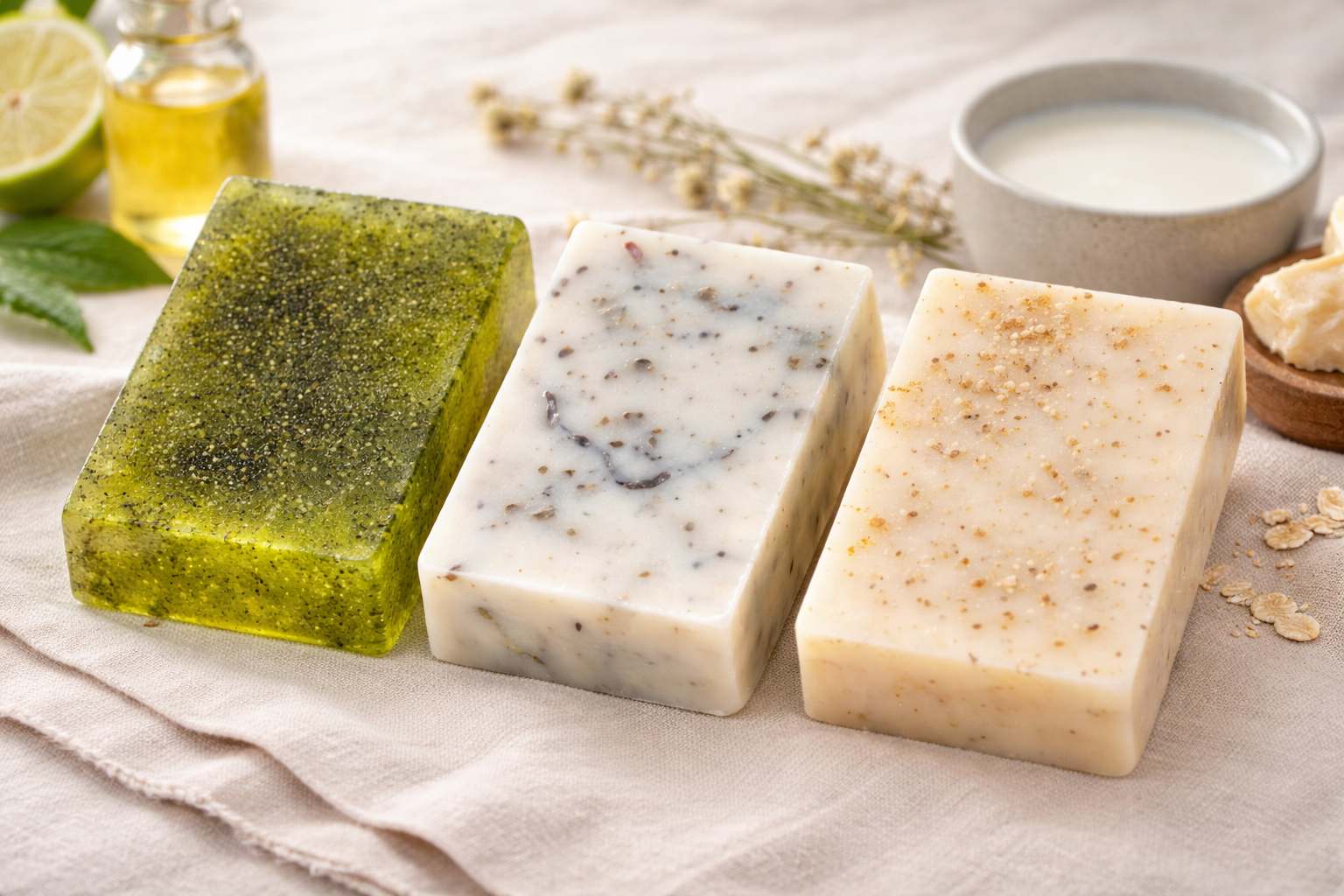
At Healing Soil, we make three bases - goat milk, glycerin, and shea butter - because different skin genuinely needs different things. The goat milk base uses milk as the structural ingredient, not an additive. The glycerin base retains the natural glycerin that forms during saponification. The shea butter base uses a high proportion of shea that partially survives saponification.
All three are handmade in small batches in Goa. No SLS, no parabens, no synthetic fragrance in any of them. Made to order, so the bar you receive was made recently.
If you want to try both and find which works for your skin, the starter bundle in the shop includes all three bases in one order.
Written by Healing Soil
Try the starter bundle
Four soaps to find the one your skin agrees with. ₹1,000. SLS-free, made to order from Goa.
Shipped in 4 days. Free shipping included.
See the starter bundleWant the full picture? Read our complete guide to handmade soap in India.